
Discover Brazil
A Land Shaped by Many Cultures
The first capital of Brazil was Salvador, located in the region where the Portuguese first arrived. Over time, with the expansion of trade, exploration of gold and diamonds, coffee production, and the need to further establish and protect the territory, the capital was transferred to Rio de Janeiro in 1763. Indeed, the royal family influences in music, food, art, and culture helped shape Brazilian identity. Instruments such as the violin, piano, and flute blended with African rhythms and instruments, helping give rise to choro, one of Brazil’s earliest popular music genres. Historians often describe Brazilian culture and cuisine as a rich blend of Indigenous, Portuguese, and African influences, making Brazil one of the world’s great cultural melting pots.
For a long time, Rio de Janeiro became the center of the Portuguese Empire. This historic relocation brought new cultural influences, trade opportunities, architecture, education, and culinary traditions that helped shape modern Brazil. The blending of European refinement with the country’s existing Indigenous and African roots further enriched Brazilian culture and cuisine.
The Portuguese Royal Family & Brazil’s Transformation
With the arrival of the Portuguese royal family in 1807, after fleeing the invasion of Napoleon Bonaparte, a new chapter began for Brazil. The royal family brought the entire Portuguese court with them, along with members of the European elite. Rio de
Janeiro became the center of the Portuguese court outside of Europe.
Along with the royal family came European influences in music, food, art, and culture, which helped shape Brazilian identity. Instruments such as the violin, piano, and flute blended with African rhythms and instruments, helping give rise to choro, one of Brazil’s earliest popular music genres. Historians often describe Brazilian culture and cuisine as a rich blend of Indigenous, Portuguese, and African influences, making Brazil one of the world’s great cultural melting pots.
For a time, Rio de Janeiro became the center of the Portuguese Empire. This historic relocation brought new cultural influences, trade opportunities, architecture, education, and culinary traditions that helped shape modern Brazil. The blending of European refinement with the country’s existing Indigenous and African roots further enriched Brazilian culture and cuisine.

A Country Rich in Natural Diversity
Brazil is one of the largest countries in the world by land mass and is home to many different geographical regions, each contributing its own ingredients and culinary traditions. The Amazon rainforest, tropical coastlines, fertile farmland, and southern plains all influence the foods enjoyed throughout the country.
Brazil has long been known as a major exporter of coffee and sugar cane and is one of the world’s leading producers of meat proteins. Its extensive coastline also provides an abundance of fresh seafood. This rich combination of landscapes and cultures has created distinct regional cuisines found throughout the country.
Feijoada — Brazil’s National Dish
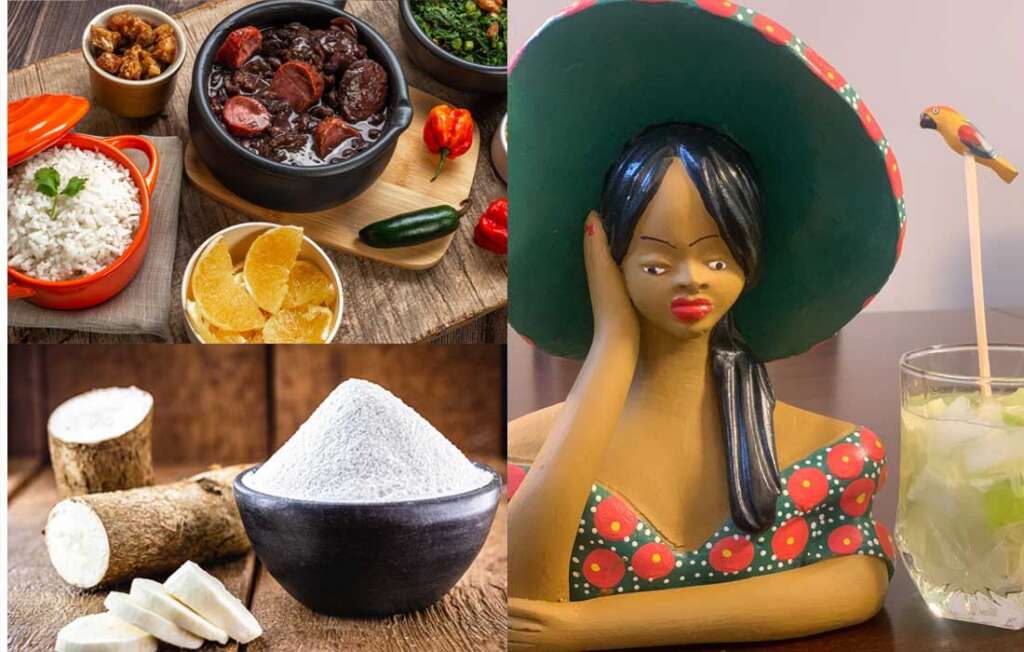
Feijoada is considered Brazil’s national dish. It is traditionally prepared by slowly cooking black beans with smoked meats for several hours, allowing the flavors to fully develop. Feijoada is commonly served with white rice, collard greens, and farofa —
toasted yuca flour seasoned with onion, garlic, and spices.
Each region of Brazil has adapted the preparation in its own way, but the heart of the dish remains the same: the beans and meats are slowly cooked together in one pot, creating a rich and comforting meal rooted in tradition.
Cassava — The Queen of Brazilian Cuisine
When the Portuguese arrived in Brazil, Indigenous communities were already cultivating and eating manioc, also known as cassava. Because of its importance throughout Brazilian history, cassava is often considered the queen of Brazilian cuisine. “According to Infoteca da Embrapa, Father José de Anchieta referred to manioc in 1553 as the bread of the tropics.”
The Portuguese introduced potatoes to Brazil while also bringing manioc from Brazil to other parts of the world. In northern and northeastern Brazil, where the Portuguese first settled, manioc was already a staple food source for the local population. Nutritious and able to grow in dry climates with little water, cassava became essential to everyday cooking and remains a foundational ingredient in northeastern Brazilian cuisine today.
In southern and southeastern Brazil, food traditions developed with stronger European influences, especially in cities such as São Paulo and Rio de Janeiro. However, cassava remains one of Brazil’s most important and recognizable ingredients throughout the country. Brasil Comes to You proudly uses manioc in many dishes, and it can often be found on the West Coast and in Asian markets. Today, some of the world’s largest manioc producers are: Nigeria, Ghana, Vietnam, Thailand, Brasil in fifth position.
Brazil’s Signature Cocktail
Caipirinha is Brazil’s national cocktail, made with cachaça (sugar cane rum), sugar, fresh lime, and ice. Its refreshing flavor perfectly reflects the vibrant spirit of Brazil.
The warm climate, welcoming hospitality, colorful culture, music, and joyful energy make Brazil a truly special and unforgettable country.